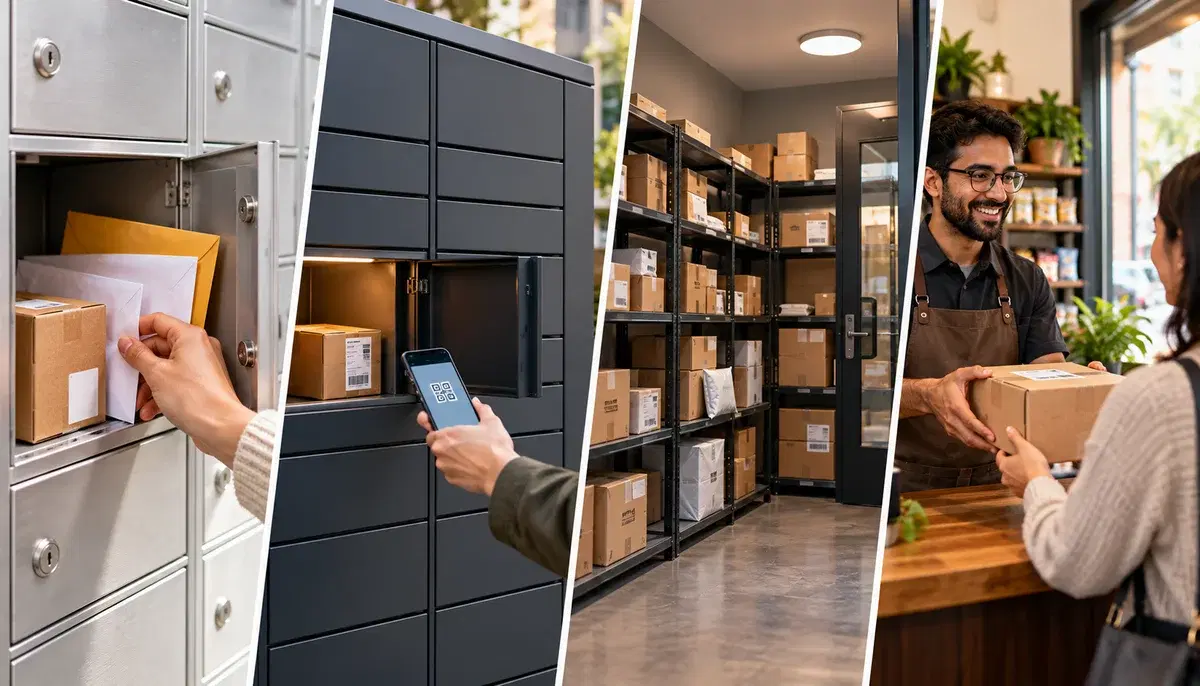
PO Box vs Parcel Locker vs Package Room vs Package Receiving Service: An Honest Comparison
Published October 29, 2026
Choosing a package receiving option
No single package receiving option is best for everyone. A USPS PO Box is right if you only get USPS mail. A parcel locker fits if you mostly order from one carrier and value 24/7 access. A building package room is fine when your building is genuinely secured and logs deliveries. A package receiving service is the most flexible option. It accepts every major carrier and hands packages to you in person, which makes it the strongest fit for anyone who orders from multiple retailers or lives without a doorman.
How the four options compare at a glance
Each option is explained in more detail in its own section below.
What to compare | USPS PO Box | Parcel locker | Building package room | Package receiving service |
Carriers accepted | USPS only | Usually one carrier only | All (if delivery is allowed) | All major carriers |
Access hours | Lobby hours vary | 24/7 self-service | Building-dependent | Partner's operating hours |
Theft exposure | Low (locked) | Low (locked) | Variable; shared access | Low (handed in person) |
Size and weight limits | 5 sizes; small only | Locker-size dependent | Building-dependent | Up to 50 lbs in weight / 2x2x2 ft in size |
Setup | In-person + ID + form | App signup | Built into lease | Online in minutes |
Term length | 3, 6, or 12 months | Monthly or pay-per-use | Tied to lease | Monthly subscription, cancel anytime |
Best for | USPS-only mail users | Single-carrier shoppers | Buildings that allow it | Frequent multi-carrier shoppers |
USPS PO Box
What a PO Box is
A PO Box is a locked compartment inside a USPS post office, rented from the Postal Service. You apply at a post office, choose a size, and pick up mail from your assigned box during the post office's lobby hours.
What a PO Box can and can't receive
A PO Box can only receive items delivered by USPS. It cannot accept packages from UPS, FedEx, DHL, or most Amazon shipments, because those carriers don't deliver to a USPS facility. USPS does offer a feature called Street Addressing for some PO Box customers, which allows certain private-carrier deliveries, but availability and conditions vary by location.
How to set up a PO Box
Setup requires applying in person at a post office, presenting two forms of ID (including one government-issued photo ID), and committing to a 3, 6, or 12-month term. PO Boxes come in five sizes from XS to XL, and the smaller ones fit only letters and small parcels, not most online-shopping packages.
When a PO Box is the right answer
A PO Box is the simplest, cheapest option if you only need to receive USPS mail: bills, official mail, magazines, and small letters. It's also the right choice if you specifically need a secured mailing address that has no street component (some legal and financial uses require this).
Parcel locker
What a parcel locker is
A parcel locker is an automated, self-service compartment where a carrier deposits your package and sends you a code to open it. The most familiar example is Amazon Hub Locker, but several carriers and private operators run their own locker networks.
What a parcel locker can and can't receive
Most parcel lockers are operated by a single carrier or a single retailer's ecosystem. An Amazon Hub Locker accepts Amazon shipments. A UPS Access Point accepts UPS. There are a few exceptions, including municipal lockers (like LockerNYC in New York) that accept multiple carriers, but those are limited in number and not available in every neighborhood.
How a parcel locker works
Setup is usually free: you select the locker as your shipping address during checkout (Amazon, for example, lets you choose a Hub Locker location at the address step), and you pick it up using a unique code sent to your phone. Lockers operate 24/7, which is their biggest advantage. The biggest constraints are physical: lockers come in fixed sizes, so larger packages may not fit, and during peak season nearby lockers fill up and the package gets rerouted.
When a parcel locker is the right answer
A parcel locker is a good fit if you mostly order from a single ecosystem (typically Amazon), live or work near a locker location, and value pickup at any hour. It's less suitable for multi-carrier shoppers or for anyone who regularly receives larger items.
Building package room
What a building package room is
A package room is a designated area in your apartment or office building where carriers leave packages for residents to collect. Some are staffed by building personnel and log every delivery; others are unattended rooms with a key code or fob access.
What a building package room can and can't receive
In principle, a building package room accepts deliveries from any carrier. The carrier hands the package to whoever is at the door (staff, doorman, or self-access entry). In practice, acceptance depends on your building's policy: some buildings refuse oversized items, some restrict acceptance hours, and some don't allow drop-offs at all.
How a building package room works
Setup is automatic if your building has one: your home address is the package room. Pickup is normally on the honor system in unattended rooms, or by signature with the doorman or concierge in staffed buildings.
The security caveat
A package room is only as secure as your building. In staffed, well-logged rooms, package theft is rare. In shared rooms where the door is sometimes propped, where residents and visitors all have the same code, or where no one logs deliveries, packages do get taken, sometimes by other residents and sometimes by people who follow a resident through the door.
When a building package room is the right answer
A building package room is a good fit when your building genuinely staffs and logs deliveries, your packages have been reliably arriving, and you're home often enough to retrieve them quickly. It's free, immediate, and works for any carrier.
Package receiving service
What a package receiving service is
A package receiving service gives you an alternate shipping address, typically a vetted local retail business (a café, convenience store, pharmacy, gift shop), where packages are accepted on your behalf and held for you to collect. Delivery Amigo is one example. The defining feature is that a person, not a machine or a shared room, receives and releases each package.
What a package receiving service can and can't receive
Because a person accepts the package at the partner location, a package receiving service works with any major carrier: USPS, UPS, FedEx, DHL, Amazon, and regional couriers. The carrier doesn't need to belong to any specific network; they simply deliver to the partner's street address as they would for any business.
How a package receiving service works
Setup is online and takes a few minutes. You subscribe to a plan, choose a partner location near you, and use that location's street address as your shipping address. When a package arrives, the partner logs it and you get notified. You collect the package by showing the unique pickup PIN assigned to you during subscription to the location partner. If you want someone else to collect on your behalf, they bring your pickup PIN plus a valid government-issued photo ID.
How a package receiving service handles security and theft
Packages are stored in a non-public area at the partner location and released only on presenting the correct pickup PIN. The package is never left in a hallway, on a step, or in a shared room. The single behavioral factor most associated with package theft, i.e. packages sitting unattended, is removed by design.
Pricing and terms
Delivery Amigo plans start at $7.50 per month for up to 5 packages (Basic) and $15.00 per month for up to 15 packages (Premium). Packages beyond the monthly limit are still accepted and charged at $2 each for that month. Subscriptions are monthly, with no long-term commitment, and you can cancel anytime from your dashboard.
When a package receiving service is the right answer
A package receiving service is the strongest fit if you order from multiple retailers and carriers, live in a walk-up or doorman-less building, travel often, or simply don't want packages sitting at your door. It's less necessary if you only receive USPS mail or already have a reliably secure way to receive packages at home.
How to choose the right option for you
A practical decision path:
1. If you only receive USPS mail and small letters, get a PO Box.
2. If you order almost exclusively through Amazon and there's a Hub Locker near you, use Amazon Locker.
3. If you live in a building with a genuinely staffed and logged package room and your packages reliably arrive, stick with what you have.
4. If you order from multiple carriers, travel often, live in a walk-up or doorman-less building, or have lost packages from your current setup, a package receiving service is the most flexible answer.
Comparison FAQ
Can a PO Box receive an Amazon package?
Generally no. A PO Box receives only USPS mail. Amazon ships most orders through UPS, FedEx, or its own logistics network, none of which deliver into USPS PO Boxes. There are limited exceptions if the seller uses USPS Media Mail or USPS shipping specifically, and if you've enabled USPS Street Addressing on your PO Box.
Are parcel lockers really only single-carrier?
Most are. An Amazon Hub Locker accepts Amazon shipments; a UPS Access Point accepts UPS. Multi-carrier public lockers like LockerNYC exist but are limited to specific cities and neighborhoods.
Is a package room safer than a doorstep?
Usually somewhat, but not always. A staffed, logged package room is much safer. An unattended room with shared access is often not meaningfully safer than a doorstep, especially in larger buildings.
How much more expensive is a package receiving service than a PO Box?
A PO Box's annual cost varies by location and size, but starts at roughly the same monthly rate as the Basic plan from a package receiving service. The difference is what you get: a PO Box accepts USPS-only mail; a package receiving service accepts every carrier and handles full-size packages.
Can I use more than one of these at once?
Yes. Many people use a PO Box for sensitive mail and a package receiving service for online orders. The two solve different problems.
What if I move?
A PO Box is tied to a specific post office. A parcel locker is tied to a specific physical location. A building package room is tied to your lease. A package receiving service is the most portable. If Delivery Amigo operates in your new city, you can change your partner location without changing any other details.
When none of these is the right answer
If you're rarely home and only receive a handful of letters a year, you may not need any of these: your mailbox is enough. If your building has on-site staff who reliably receive packages and notify you, none of these adds much over what you already have. The point of comparing options honestly is to identify the smallest, simplest solution that actually solves your problem.
Choose your package receiving option
If a package receiving service fits your situation, Delivery Amigo offers locations across all five NYC boroughs and in major cities nationwide. Setup is online, and you can cancel anytime. Find a location.
Related reading on package receiving
● In New York? See our guide to securing your online deliveries with NYC package receiving services.
● If your pickup spot keeps filling up, read what to do when Amazon Lockers are full.
● Traveling or splitting time between cities? Learn how to receive packages at your destination anywhere in the US.