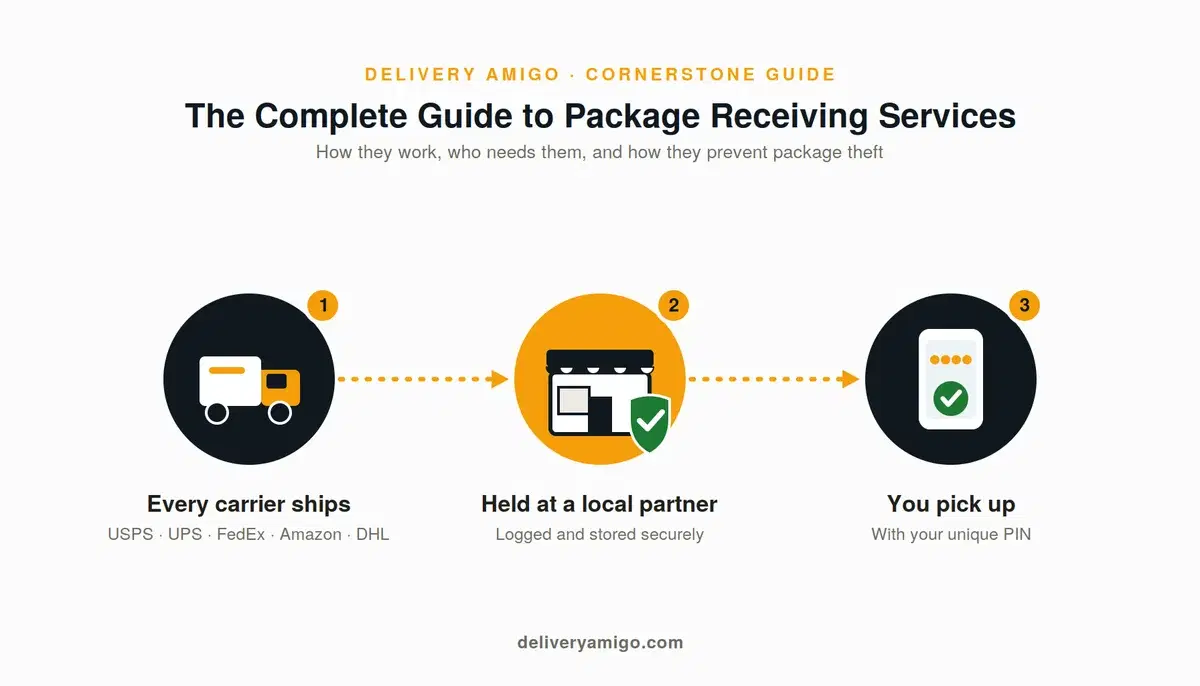
The Complete Guide to Package Receiving Services: How They Work, Who Needs Them, and How They Help Prevent Package Theft
Updated October 19, 2026
A package receiving service gives you a secure alternate address at a local business that accepts deliveries from every major carrier and holds them until you pick them up. It’s the simplest way to stop porch theft and missed deliveries. This guide covers how it works, who needs one, how it compares to PO Boxes, lockers, and CMRAs, and when you don’t need one at all.
Table of Contents
1. What a package receiving service is
2. Why package receiving services exist: the unattended-window problem
3. How a Delivery Amigo pickup works, step by step
4. What package receiving services accept (and what they don't)
5. Who package receiving services are for
6. How a package receiving service compares to the alternatives
7. Where package receiving services operate: the geographic picture
8. Frequently asked questions
9. When a package receiving service isn't necessary
10. Glossary of related terms
11. Further reading: the fact-store cluster
1. What a package receiving service is
A package receiving service is a paid service that gives you an alternate shipping address, usually a vetted local business near you, where your online orders are accepted on your behalf and held until you collect them.
Instead of a package being left at your door, in your lobby, or in a shared building room, packages are handed to a person who logs it, stores it securely, and releases it to you using a unique pickup PIN.
The service exists for one reason: the single biggest cause of package theft is packages being left unattended, and a package receiving service removes that exposure by design.
A package receiving service is structurally different from three things it's often confused with:
A PO Box is a USPS service that accepts USPS-shipped mail only. A package receiving service accepts shipments from every major carrier.
A parcel locker (Amazon Hub, UPS Access Point, FedEx Hold at Location) is a self-service locked compartment tied to one carrier's ecosystem.
A CMRA (Commercial Mail Receiving Agency) is a legally distinct mail-handling service primarily designed to provide a registered street address for business or legal purposes, often at higher cost.
These distinctions matter because each alternative solves a different problem.
A PO Box solves mail privacy.
A parcel locker solves single-carrier convenience.
A CMRA solves the need for a registered business address.
A package receiving service solves the multi-carrier package theft and missed-delivery problem.
2. Why package receiving services exist: the unattended-window problem
Most package loss is not a carrier problem. UPS, FedEx, USPS, and Amazon all have broadly similar loss rates once a package is in transit. What changes loss rates dramatically is what happens at the destination, specifically, whether the package is left somewhere unattended. A package on a doorstep, in an unsecured lobby, or in a shared package room is exposed to opportunistic package theft. A package handed to a person at a vetted location is not.
The "unattended window", the time between when a carrier marks a package "delivered" and when an authorized human receives it, is the structural problem package receiving services solve. Public data on this problem is striking:
An estimated 104 million packages were stolen in the United States in 2025, costing consumers about $15 billion in direct losses and, once retailer replacement and refund costs are added, at least $37 billion in total economic impact [source: SafeWise 2025 US Package Theft Report].
Apartment and condo dwellers face more than three times higher package theft rates than single-family homeowners, a structural premium driven by shared building access, package volume concentration, and reduced doorstep visibility [source: Security.org 2025 Annual Package Theft Report].
Package theft counts are highest in dense urban areas, reflecting both higher delivery density and more apartment-heavy housing[source: Security.org 2025 Annual Package Theft Report].
62% of online shoppers report anxiety while waiting for packages to arrive, with nearly one in four reporting moderate-to-severe anxiety that a package will be stolen [source:Security.org 2025 Annual Package Theft Report].
This explains a counterintuitive finding: simply switching carriers does not meaningfully reduce package theft. Removing the moment a package sits exposed does.
The structural causes of "missing" packages fall into three categories:
Package Theft, a package was delivered to an unattended location and stolen before the recipient collected it. This is the largest single category and the one where the unattended window matters most.
Carrier misdelivery, the carrier left the package at the wrong address. The package isn't stolen; it's simply at someone else's house. Many “missing” packages are eventually recovered when the recipient checks with neighbors or building staff.
Carrier-side loss, the package was lost in transit before delivery. This is the smallest category by volume and the one where the carrier bears primary responsibility. Most lost-in-transit packages eventually surface within a week.
A package receiving service eliminates the first cause entirely (no unattended window), reduces the second cause dramatically (delivery to a single verified address, not your varying residence), and is unaffected by the third (which would happen with any shipping destination).
3. How a Delivery Amigo package pickup works, step by step
Choose a partner location. Visit www.deliveryamigo.com to browse partners near you. The service maintains a network of vetted local businesses (cafes, convenience stores, pharmacies, gift shops, mailbox stores) that have signed on to receive packages. Pick one near where you live, work, or are traveling to. Many customers choose a partner along their daily commute or near a frequently-visited spot.
Subscribe to a plan. Basic is $7.50/month (up to 5 packages per month) and Premium is $15.00/month (up to 15 packages per month). Packages over the monthly limit are still accepted and charged at $2 each.
Use the partner address. When checking out from any retailer, enter the partner's address as your shipping address for packages to be delivered. Use the address exactly as the partner provides it, don't modify the formatting or add "c/o" prefixes, which can cause carriers to flag the package for special handling.
Your package is logged on arrival. When the carrier delivers, a staff member at the partner location accepts the package, logs it into the service's system, and you receive a notification.
Collect your package. Visit the partner location during their operational hours and show your unique pickup PIN to collect packages. If someone else is collecting on your behalf, they need to bring your pickup PIN and a valid government-issued photo ID for the location partner to verify and release the package.
You have 7 days from the time the partner logs your package to collect it. Beyond that, a $2 late fee extends the window by another 7 days. If you are traveling, on a research trip, in a clinical rotation, or working long hours, contact us, the holding window can usually be extended at the same rate.
This five-step workflow is what makes package receiving services structurally different from every alternative on the market. The "human-in-the-loop" handoff at the partner location is the part that removes the unattended window, and the unique pickup PIN authorization is the part that prevents unauthorized pickup.
4. What package receiving services accept (and what they don't)
What's accepted
Because a person, not a machine, receives the package, package receiving services accept package deliveries from any major carrier:
USPS: parcels and packages from USPS-shipped retailers
UPS: standard packages, including UPS Ground and overnight
FedEx: standard packages, including Ground and Express
Amazon: packages shipped via Amazon Logistics, UPS, USPS, or other carriers Amazon uses
DHL: international and domestic packages
Regional couriers and most other carriers: any online packages that can be addressed and delivered to a location address
Standard size and weight limits apply. Standard package limits are up to 2 ft × 2 ft × 2 ft and under 50 lbs. Oversized items may be accepted with an additional fee at some locations; contact Delivery Amigo support before shipping anything large.
What's not accepted
A package receiving service is not a freight depot or a storage warehouse. For safety and partner-business reasons, the following categories are typically prohibited:
Hazardous materials, explosives, or flammable liquids
Firearms, ammunition, or weapons
Illegal drugs or controlled substances
Perishable food or refrigerated items
Living animals or human remains
Currency, precious metals, or jewelry
Visit our Terms page for the complete list.
Why these restrictions exist
Two structural reasons drive these prohibitions.
First, partner businesses are not licensed for hazardous-materials handling or storage of restricted items; partnering with a package receiving service doesn't convert a corner store into a freight terminal.
Second, certain shipment categories require chain-of-custody verification that the partner can't provide without specialized infrastructure.
For shipments that fall into these prohibited categories, alternative solutions like CMRAs, freight handling services, or direct carrier hold-at-station services may be more appropriate.
5. Who package receiving services are for
A package receiving service may not be suitable for everyone, but for several specific audiences, it's structurally the best available option.
Apartment and no-doorman residents
If you live in a walk-up, a doorman-less building, or anywhere packages get left in a shared lobby, a package receiving service is the cleanest fix. Your package is never in a public space.
The case is especially strong if you live in an apartment building with shared lobby access where neighbors, contractors, dog walkers, and ex-residents may have entry. The "more than three times" higher theft rate apartment residents face nationally is driven largely by this structural exposure.
Frequent online shoppers
If you order from many retailers and carriers, the multi-carrier acceptance of a package receiving service is the practical answer. You don't have to track which carrier is bringing which package or hope they all arrive when you are at home.
Frequent shoppers also benefit from the cumulative protection: a single missing package incident might not justify a $7.50-$15 monthly subscription, but over a year of consistent shopping, the cumulative cost of package theft, refund-and-replacement cycles, and missed deliveries typically exceeds the subscription cost.
Travelers and short-term renters
If you are traveling to a city for a trip, you can ship purchases ahead to a partner location near your destination and collect on arrival. This is useful for Airbnb stays, hotel stays, and short business trips where you don't have any arrangements to accept early deliveries.
The "ship-ahead" pattern is especially common in cities where Airbnb hosts won't accept guest packages or where hotels charge handling fees for guest deliveries. New York, Miami, and Los Angeles see the highest concentration of ship-ahead users.
Snowbirds and seasonal residents
If you split time between two homes, like the roughly one million Americans who spend October through April in Florida and the rest of the year up north, a package receiving service handles deliveries while you're away, so packages don't sit on an empty doorstep waiting for you to return. [source: Florida Smart, Snowbird Season in Florida, drawing on University of Florida BEBR research].
People who value privacy
Using a partner address means retailers and carriers don't see your home address. For anyone running a side business, selling online, or simply wanting to keep their home address off retailer databases, this is a meaningful benefit.
Address privacy has become more important as data breaches at major retailers have grown. A home address that's never entered into a retailer's database can't be exposed in a breach. For people concerned about doxxing, stalking, or identity theft, this is sometimes the most compelling single reason to use a package receiving service.
People in cities with documented high package theft
If you live in one of the metros where SafeWise's 2025 rankings show concentrated package theft, Chicago, NYC, Miami, Houston, Baltimore, Dallas–Fort Worth, Los Angeles, San Antonio, Detroit, or Virginia Beach, then the structural exposure is high regardless of housing type. A package receiving service is the most reliable way to opt out of the local theft environment [source: SafeWise, "Worst Metro Cities for Package Theft" 2025 rankings].
6. How a package receiving service compares to the alternatives
The simplest way to understand a package receiving service is to compare it to what it's not.
Feature | USPS PO Box | Parcel Locker | Building Package Room | CMRA | Package Receiving Service |
Carriers accepted | USPS only | Usually one carrier | Building-dependent | All major carriers | All major carriers |
Hours | Post office hours | 24/7 self-service | Building-dependent | Business hours | Partner business hours |
Setup | In-person + ID | App signup | Built into lease | In-person + business docs | Online in minutes |
Theft exposure | Low (locked) | Low (locked) | Variable | Low (staffed) | Low (handed in person) |
Multi-package handling | Limited by box size | Locker size limit | Building-dependent | High | High |
Authorized pickup by other person | Limited | Limited | Yes | Yes | Yes (using pickup PIN + valid government-issued photo ID) |
Privacy of home address | Yes | No | No | Yes | Yes |
Monthly cost | $5-$30 | Free | Free | $25-$100+ | $7.50-$15 |
Best fit | USPS-only mail | Single-carrier shoppers | Doorman buildings | Business registered address | Frequent multi-carrier shoppers |
The PO Box trade-off
A PO Box is fine if you only receive USPS mail. The limitation is structural: USPS doesn't accept packages from UPS, FedEx, DHL, or most Amazon shipments into a PO Box address. Some PO Boxes can receive packages from other carriers; acceptance depends on availability and USPS restrictions. Setup requires an in-person visit to a post office with ID, and pricing varies by location.
The parcel locker trade-off
Parcel lockers like Amazon Hub Locker, UPS Access Point, and FedEx Hold at Location offer 24/7 self-service pickup but are typically tied to a single carrier's ecosystem. An Amazon Hub Locker accepts Amazon shipments only; a UPS Access Point accepts UPS only; a FedEx Hold at Location accepts FedEx only. For shoppers who order from multiple carriers, lockers solve only one carrier's worth of the problem.
The building package room trade-off
Many apartment buildings have package rooms managed by building staff or accessible by keypad. Package room safety varies dramatically by building; staffed-and-logged setups can be as safe as a package receiving service; unstaffed and unrestricted setups are functionally semi-public storage.
The structural question to ask: who actually has access to your building's package room, and does anyone sign for deliveries?
The CMRA trade-off
A Commercial Mail Receiving Agency (CMRA) accepts multi-carrier shipments and provides a legal mailing address, but typically costs 2-5x more than a package receiving service ($25-$100+ per month versus $7.50-$15) and requires in-person setup with business documentation.
CMRAs make sense when you specifically need a registered business address for legal or tax purposes; package receiving services make sense when the primary need is reliable package delivery.
7. Where package receiving services operate: the geographic picture
Delivery Amigo operates package receiving locations in major US metros, with the densest coverage in cities where package theft is most concentrated, and apartment housing is most common.
Current coverage includes:
New York City and all five boroughs, Manhattan, Brooklyn, Queens, and the Bronx, with Manhattan particularly dense given that the overwhelming majority of its housing is in apartment buildings.
In addition, Delivery Amigo operates across major cities, suburbs, and neighborhoods nationwide, giving customers access to secure package receiving locations wherever they live, work, or travel.
The cluster is expanding to additional metros throughout 2026.
8. Frequently asked questions about package receiving services
Is a package receiving service the same thing as a PO Box?
No. A PO Box is a USPS service that receives only USPS-delivered mail. A package receiving service is a separate, third-party service operated through local businesses that accepts deliveries from any carrier.
Do I have to be there when my package arrives?
No. The whole point of the service is that the location partner or their staff accept the package on your behalf. You collect it at your convenience within the pickup window.
What if my package is damaged or missing?
If a package arrives damaged or doesn't arrive at all, the responsibility depends on where the issue occurred. In-transit issues are between you and the carrier (the same as if the package were shipped to your home). Once a package is logged by the partner, the service tracks it through pickup.
Can I use a package receiving service as my legal mailing address?
Generally, a package receiving service is intended for parcels, not as a registered legal address (for tax filings, government correspondence, or banking). For a registered mailing address, you typically need a Commercial Mail Receiving Agency (CMRA), which is a different service with stricter compliance requirements.
What carriers won't deliver to a package receiving service?
Most major carriers will. The only common limitation is on specialty deliveries that require a residential address (some appliance installations, some restricted-substance shipments), those wouldn't ship to a business address regardless.
How is this different from having packages held at a UPS Store or FedEx Office?
A UPS Store will only hold UPS packages (and only if you have an account with them). A FedEx Office will hold FedEx packages. A package receiving service takes any carrier into a single address.
What happens if I move? Do I have to re-set up the service?
We're here to make the transition as smooth as possible. Just reach out to the Delivery Amigo support team for assistance.
Can I authorize multiple people to pick up packages for me?
Yes. You can share your pickup PIN with as many people as you authorize. Each authorized pickup person brings the pickup PIN and their own valid government-issued photo ID. Common patterns include sharing access with roommates, partners, building managers, or personal assistants.
How does Delivery Amigo handle packages while I'm traveling for longer than 7 days?
Contact us before you travel, and we can extend the holding window at the standard $ 2-per-7-day rate. Many customers use this for vacations, business travel, research trips, and snowbird seasons.
Does Delivery Amigo work for international shipments?
Yes, for inbound international packages. DHL, FedEx International, USPS Priority Mail International, and UPS Worldwide all deliver to Delivery Amigo locations.
How private is my address really?
Retailers and carriers see only the partner location address. Your home address never enters their database when you ship through a Delivery Amigo location. Some customers use Delivery Amigo specifically as a privacy layer for online shopping, side businesses, or doxxing protection.
9. When a package receiving service isn't necessary
Honestly, not everyone needs one. A few cases where a package receiving service is probably overkill:
You receive maybe one package a month, and your existing setup has been reliable.
You only get USPS mail, in which case a PO Box is cheaper and equally safe.
Your building staff already accepts and logs every package, and your packages have been arriving without issue.
You live in a single-family home in a low-package theft suburb or rural area, with a porch that's screened from the street and a neighborhood with documented low theft rates.
Your shipping needs are exclusively from one carrier (almost always Amazon), and an Amazon Hub Locker near you has been working reliably.
We share these honestly because we'd rather you choose Delivery Amigo because it's the right answer for your situation than because we hid the alternatives.
The service is most valuable when packages are arriving unreliably, when you can't be home for delivery, when you're shipping to a place you don't yet live (a destination, a new city, a short-term rental), or when you live in a city, neighborhood, or housing type with documented elevated package theft risk.
10. Glossary of related terms
Authorized pickup — The mechanism by which someone other than the primary account holder collects a package. Requires the unique pickup PIN plus a valid government-issued photo ID for a partner location to release the package to the person authorized.
CMRA (Commercial Mail Receiving Agency) — A USPS-registered third party that receives mail and packages on behalf of others, typically for the purpose of providing a registered business address.
Doorman/concierge — Building staff who accept and log packages at residential buildings, typically in larger apartment buildings and luxury condos.
Hold-at-location services — Carrier-specific programs (UPS Hold for Pickup, FedEx Hold at Location, USPS Hold for Pickup) where a single carrier holds packages at their own facility for customer pickup.
Package room — A shared room in an apartment or condo building where packages are held, with access ranging from staffed-and-logged to keypad-only to unrestricted.
Parcel locker — A self-service locked compartment installed in a public location, typically operated by a single carrier (Amazon Hub Locker, UPS Access Point, FedEx Hold at Location).
Pickup PIN — A unique identifier issued to each Delivery Amigo customer that authorizes package retrieval at a partner location. Note: Your Pickup PIN is assigned to your subscription; it is a single identifier for you as a subscriber, not a separate PIN per package. You use the same PIN to collect any and all packages associated with your subscription.
Porch piracy — Theft of packages from doorsteps or other unattended residential delivery locations. Documented at about 104 million packages stolen in 2025.
Ship-ahead — The practice of shipping purchases to a destination address before arrival, common among travelers, snowbirds, and short-term renters.
Unattended window — The time between when a carrier marks a package "delivered" and when an authorized recipient actually collects it. The longer this window, the higher the package theft risk.
11. Further reading: the fact-store cluster
For deeper exploration of the topics this guide introduces, see our fact-store reference articles and city-specific guides:
Understanding the problem:
For the full breakdown of how package theft is measured, who it hits hardest, and where it’s worst, see our U.S. package theft statistics.
The Complete Guide to Porch Piracy in the United States. How package theft happens, why it’s rising, and what actually stops it.
Receiving Packages Without Giving an Address. How to keep your home address off retailer databases by shipping to a partner location instead.
City-specific guides
· Package Pickup in New York City. Manhattan apartment density and the doorman-vs-walk-up split.
· Package Pickup in Boston. Triple-decker housing and the winter delivery problem.
· Package Pickup in Philadelphia. Row-home stoops and one of the highest-loss metros.
· Package Pickup in Los Angeles. The lone West Coast metro in the 2025 top 10.
· Package Pickup in San Francisco. Urban density and the apartment-housing theft premium.
· Package Pickup in Miami. Condo variability and the snowbird seasonal swing.
Special situations:
· How Airbnb Guests and Hosts Can Receive Packages Safely. Shipping ahead to a pickup point when you’re staying in a short-term rental.
· Does Homeowners or Renters Insurance Cover Stolen Packages? What’s actually covered, deductibles, and why filing a claim often isn’t worth it.
· What to Do Immediately After a Package Is Stolen. The first steps: confirm the “delivered” scan, check with neighbors, and file with the carrier and retailer.