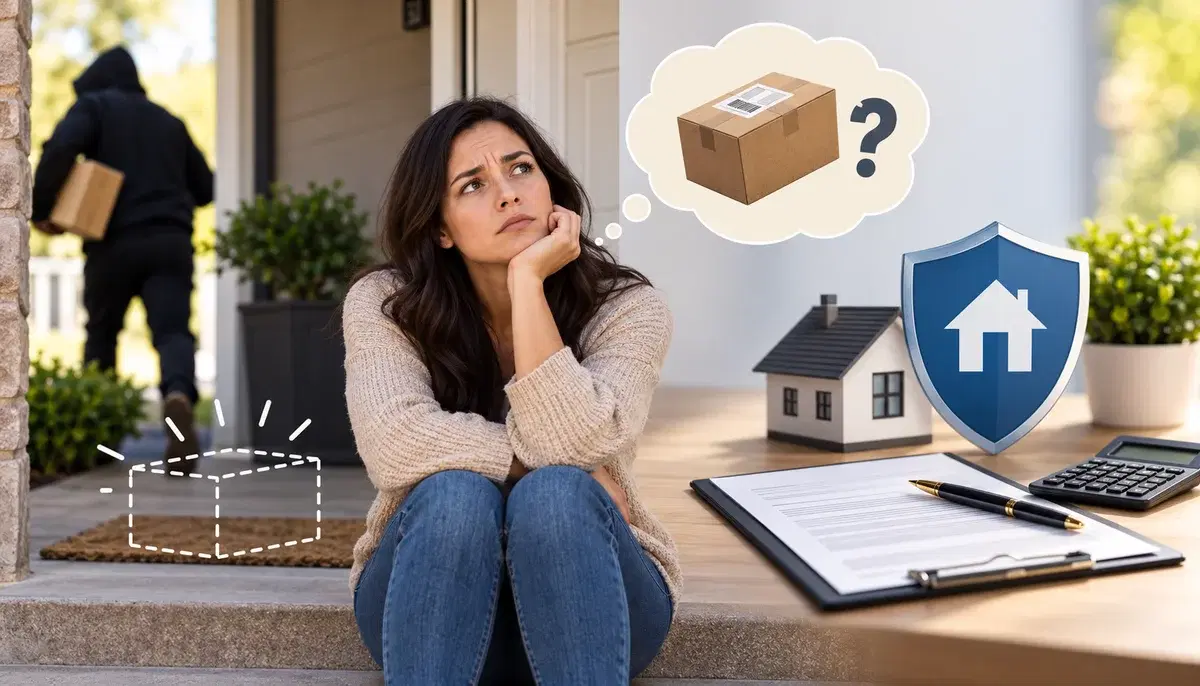
Does Homeowners or Renters Insurance Cover Stolen Packages?
Published September 4, 2026
A package vanishes off your porch and you wonder: is this something my insurance covers? Usually, yes, a stolen package counts as personal property theft under most homeowners and renters policies. The catch is the deductible, which is often higher than the package was worth, so most people are better off getting a refund from the retailer or their credit card instead. Here's how the coverage actually works and when it's worth using.
This article is general information, not insurance advice, always check your own policy for the details that apply to you.
The short answer
Most homeowners and renters insurance policies include personal property coverage that extends to theft, and that typically covers packages stolen from your porch (even off-premises theft, like a package taken from a hotel or a car). But because a standard deductible is often $500–$1,000, frequently more than a single stolen package is worth, filing a claim usually isn't worthwhile for everyday orders. It makes sense mainly for high-value items or multiple packages stolen at once.
How the coverage works
Personal property coverage. Your belongings are covered against named perils including theft. A delivered package that's been stolen is your property, so it generally falls under this coverage, whether it was taken from your doorstep, your building lobby, or even away from home.
Off-premises theft. Most policies extend personal property coverage to items stolen away from your residence, often at a reduced percentage of your total coverage. That's why a package stolen while you are traveling can still qualify.
Named recipient. Coverage typically applies to the policyholder and household members. A package you ordered for someone outside your household may not be covered.
Why the deductible usually makes it not worth it
Here's the practical reality. If your deductible is $1,000 and the stolen package was worth $80, filing a claim gets you nothing, you'd pay the whole loss yourself and still have used a claim. Even for a $400 item under a $500 deductible, there is no payout.
On top of that, filing claims can affect your record: multiple small claims may raise your premium at renewal or affect your eligibility. For that reason, insurance is best reserved for higher-value losses that clearly exceed your deductible, a stolen laptop, several packages taken at once, or a theft tied to a larger break-in.
When filing an insurance claim does make sense
The stolen item's value clearly exceeds your deductible (e.g., a $1,500 item on a $500 deductible).
Multiple packages were stolen in one incident, adding up past the deductible.
The package theft was part of a larger burglary you are already claiming.
You have a low deductible and few prior claims.
If you do file, you will need documentation: the order receipt showing value, the tracking showing "delivered," any camera footage, and, importantly, a police report. Most insurers require a police report for a theft claim. For the full sequence, see our guide on what to do immediately after a package is stolen.
Better options for everyday stolen packages
For most orders, skip insurance and use a faster, deductible-free route:
The retailer or seller. Amazon and many retailers will refund or replace a stolen order once tracking shows delivered but you didn't receive it, usually your quickest path.
Credit card purchase protection. Many cards cover theft or non-delivery of items bought on the card; contact your issuer with your documentation.
Buyer-protection programs like PayPal or marketplace guarantees.
The real fix: keep packages off your porch
Every one of these remedies is a workaround for the same problem, a package left unattended where anyone can grab it. Package theft is a large, ongoing issue: an estimated 104 million packages were stolen nationwide in 2024, with a total economic impact of roughly $37 billion [source: SafeWise, 2025 U.S. Package Theft Report].
The most reliable prevention is to stop packages from ever sitting on your doorstep. With a package receiving service like Delivery Amigo, your deliveries go to a secure, staffed partner location near you that accepts every carrier (USPS, UPS, FedEx, Amazon, DHL), logs each package in, and holds it until you collect it with your unique PIN; no doorstep, no unattended window, no claim to file. Plans start at $7.50/month for 5 packages and $15/month for 15.
Frequently Asked Questions
Does renters insurance cover stolen packages?
Usually yes, renters insurance includes personal property coverage that extends to theft, which typically covers a package stolen from your porch or building. But the deductible often exceeds a single package's value, so it's mainly worth claiming for higher-value losses.
Does homeowners insurance cover packages stolen from the porch?
Generally yes, as personal property theft, and often even when the item is stolen away from your home. As with renters insurance, whether it's worth filing depends on whether the loss exceeds your deductible.
Is it worth filing an insurance claim for a stolen package?
Often not. If your deductible is higher than the item's value, you'd receive no payout, and multiple small claims can affect your premium. Reserve it for high-value items or multiple packages stolen at once.
Do I need a police report to claim a stolen package on insurance?
Most insurers require a police report for a theft claim, along with proof of the item's value and the "delivered" tracking record. File the police report first if you plan to claim.
What's a faster alternative to an insurance claim?
Ask the retailer for a refund or replacement first, or use your credit card's purchase protection, both are usually quicker and have no deductible. To avoid the problem entirely, use a secure package receiving service so packages are never left unattended.
Related reading
Just had one taken? Read what to do immediately after a package is stolen for the step-by-step recovery process.
New to the topic? What is porch piracy and how do you stop it? breaks down the causes and the fixes.
For the complete picture, see the definitive guide to porch piracy in the United States: the statistics, causes, and what actually works.
Shopping over the holidays? How to protect packages during the holidays covers the peak-season tactics.